
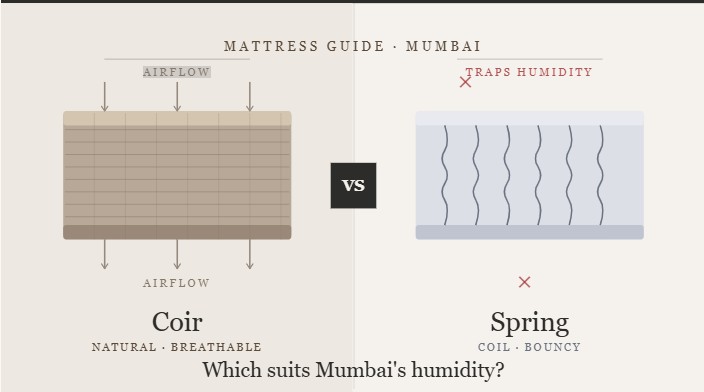
Mumbai’s weather is beautiful until your mattress isn’t. If you’ve ever woken up sweaty in June or noticed your mattress sagging faster than expected, the problem likely isn’t the heat alone — it’s humidity trapped inside your mattress. Choosing between a coir and a spring mattress in a city like Mumbai, where relative humidity regularly crosses 85% during monsoon, is a decision that directly affects how well you sleep across all twelve months of the year. This complete coir vs spring mattress guide for Mumbai breaks down both options honestly — covering breathability, durability, support, and value — so you can pick the right mattress for your home in Andheri and beyond.
Thank you for reading this post, don't forget to subscribe!Why Mumbai’s Humidity Changes the Mattress Equation
Most mattress comparisons are written for temperate climates. Mumbai is not one. According to India Meteorological Department data for the Konkan coast, Mumbai records average relative humidity between 61% in January and 91% in July. That sustained moisture in the air affects every mattress differently — some absorb it, some resist it, and some actively channel it away. In Andheri specifically, where apartments range from well-ventilated older buildings near the station to tightly sealed newer high-rises in Lokhandwala, your mattress choice has to account for airflow that you may or may not have control over.
A mattress that performs beautifully in Delhi or Pune can become a moisture trap in Mumbai — retaining heat, encouraging mould, and breaking down structurally faster than expected. Understanding how coir and spring mattresses handle humidity is the first step toward a smarter purchase.
Quick Comparison: Coir vs Spring Mattress for Mumbai
| Feature | Coir Mattress | Spring Mattress |
|---|---|---|
| Breathability | Very High | High |
| Humidity Resistance | Excellent | Good |
| Support Type | Firm | Medium to Firm |
| Motion Transfer | Low | Moderate to High |
| Durability in Mumbai | 7–10 years | 8–12 years |
| Weight | Heavy | Moderate |
| Price Range | ₹4,000–₹18,000 | ₹8,000–₹45,000 |
| Best For | Hot sleepers, back support | Couples, varied sleep positions |
| Maintenance | Flip regularly, sun-dry | Rotate regularly |
For a standardised framework on mattress material performance, the Bureau of Indian Standards mattress specifications (IS 7736) provides quality benchmarks that reputable Indian brands test against.
What Is a Coir Mattress?
A coir mattress is made from compressed coconut husk fibre — a material that has been used in Indian bedding for centuries and remains one of the most climate-appropriate mattress options for tropical regions. Modern coir mattresses are typically rubberised (bonded with natural latex) to improve durability and comfort, and are often layered with a thin foam or cotton topping for a softer sleeping surface.
Why Coir Has Stayed Relevant in Mumbai:
- Coconut husk is a natural, biodegradable material widely available in coastal India
- The fibrous structure creates thousands of micro air channels, making coir inherently breathable
- Rubberised coir resists compression over time, maintaining firmness across years of use
- Natural antimicrobial properties of coir fibres help resist mould and dust mites — a significant advantage in humid climates
Coir’s strongest quality in Mumbai’s context is its open-fibre construction. Unlike foam, which traps warm, moist air against the body, coir lets air move through the mattress freely. According to the Natural Fibre Welcoming Alliance’s research on coconut coir applications, rubberised coir maintains consistent airflow even under sustained body weight — a property that directly translates to cooler sleep in Mumbai’s sticky summer nights.
What Is a Spring Mattress?
A spring mattress uses a system of metal coils as its primary support layer, topped with foam, fibre, or fabric comfort layers. There are two main types relevant to Indian homes:
Bonnell Spring (Open Coil): The traditional, more affordable design where all coils are interconnected. Movement on one side of the bed is felt on the other — relevant for couples.
Pocket Spring: Individual coils wrapped in fabric pockets, each moving independently. This design dramatically reduces motion transfer and provides more targeted body support. Pocket spring mattresses are the premium standard recommended by sleep ergonomics researchers at the National Institute of Mental Health and Neurosciences for couples with different sleep patterns.
Why Spring Mattresses Work in Mumbai:
- The coil structure creates significant internal air space, allowing heat and moisture to dissipate
- Pocket spring mattresses contour to different body shapes, supporting back and hip alignment across sleep positions
- Long lifespan with proper rotation — quality spring mattresses maintain their structure for 10–12 years
- Widely available across price points in Andheri’s furniture market, from Duroflex and Sleepwell to premium international brands
Breathability: Coir Wins, But Spring Is Close
In terms of raw breathability, coir edges ahead of spring mattresses. The open fibrous structure of coir allows passive airflow throughout the mattress body — not just within the coil cavity as in spring designs. This matters most in Mumbai homes with limited room ventilation, where the mattress itself becomes the primary regulator of sleeping temperature.
That said, pocket spring mattresses with thin, breathable comfort layers (natural latex or cotton rather than thick memory foam toppers) perform very close to coir on breathability. The mistake many buyers make is choosing a pocket spring mattress and then adding a thick foam topper — which effectively cancels out the spring’s airflow advantage and creates exactly the humid, heat-retaining surface you were trying to avoid.
For maximum breathability in Andheri apartments without air conditioning, browse HomeSara’s breathable coir and spring mattress collection which filters by ventilation rating.
Humidity Resistance: Coir Has a Natural Edge
Both mattress types resist humidity better than foam alternatives, but they do so differently. Coir’s natural fibre composition actively repels moisture rather than just tolerating it. The rubberisation process seals the fibre surface without blocking airflow, creating a surface that neither absorbs sweat nor holds ambient humidity against the sleeper’s body.
Spring mattresses depend more on their comfort layers for humidity performance. A spring mattress with a natural latex or cotton comfort layer will perform well in Mumbai’s monsoon months. A spring mattress with a thick memory foam layer — particularly closed-cell foam — will trap moisture and become noticeably warmer and heavier through the wet season.
The Indian Sleep Association’s recommendations for tropical climate bedding specifically flag memory foam toppers as a poor choice for high-humidity regions, and advise Mumbai buyers to prioritise either natural fibre top layers or open-cell foam with breathable covers when choosing spring mattresses.
Support & Comfort: Spring Wins for Couples and Mixed Sleepers
On pure sleep comfort for the widest range of sleepers, pocket spring mattresses hold a clear advantage. The individually wrapped coils adapt to body contours, providing zoned support — firmer under heavier body parts like hips and shoulders, and responsive to lighter areas like the lower back. This adaptive quality makes pocket spring the preferred choice for:
- Couples with different body weights or sleep positions
- People who shift between back, side, and stomach sleeping through the night
- Those with existing back pain or joint concerns
Coir mattresses offer excellent firm support that is ideal for back sleepers and those who prefer a solid sleeping surface, but they are less forgiving for side sleepers whose shoulders and hips need cushioning. A coir mattress with a thin natural latex or cotton topping — available in HomeSara’s rubberised coir range — addresses this limitation without compromising the breathability advantage.
Durability in Mumbai’s Climate: Spring Edges Ahead
With proper care, a quality pocket spring mattress outlasts a rubberised coir mattress in Mumbai’s conditions. The coil structure is inherently stable — it does not compress permanently under body weight the way fibrous materials eventually do. Premium spring mattresses from established Indian brands typically carry 8–10 year warranties, with real-world lifespans of 10–12 years when rotated regularly.
Coir mattresses perform well for 7–10 years, with rubberised varieties at the longer end of that range. The main durability vulnerability in Mumbai is edge deterioration — the compressed coir at mattress edges can loosen over time in high-humidity conditions, reducing the usable sleeping surface. Choosing a coir mattress with a reinforced border stitching and a quality fabric cover significantly extends its life in coastal climates.
For both types, the Consumer Affairs Ministry’s furniture and bedding quality order recommends purchasing from BIS-certified manufacturers — a standard HomeSara applies across its entire mattress catalogue.
Price: Coir Offers Better Entry-Level Value
Coir mattresses are consistently more affordable than spring alternatives of comparable quality. A decent rubberised coir mattress for a standard double bed in Andheri starts around ₹6,000–₹10,000. An equivalent pocket spring mattress begins at ₹12,000–₹18,000. At the premium end, both types scale upward, but spring mattresses command higher prices due to the complexity of coil manufacturing and comfort layer engineering.
For first-time buyers, renters in Andheri furnishing a flat on a budget, or anyone equipping a guest bedroom, coir delivers excellent value. For a master bedroom, a growing child’s primary sleep surface, or a couple sharing a mattress daily, the investment in a quality pocket spring pays off in comfort and longevity. See HomeSara’s mattress range by budget to compare options side by side.
Who Should Choose Coir in Mumbai?
A coir mattress is the right choice if:
- You are a hot sleeper who wakes up sweaty regardless of room temperature
- Your bedroom has limited cross-ventilation or no air conditioning
- You sleep alone and prefer a firm, flat sleeping surface
- You are furnishing a children’s room, guest room, or PG in Andheri
- Your budget is ₹5,000–₹15,000 for a double or queen size
- You prioritise natural, eco-friendly materials in your home
Who Should Choose Spring in Mumbai?
A spring mattress is the right choice if:
- You share a bed with a partner and motion transfer disrupts your sleep
- You are a side sleeper or change positions frequently through the night
- Your bedroom is air-conditioned, reducing the humidity advantage of coir
- You have existing back or joint concerns requiring adaptive support
- Your budget allows ₹14,000–₹35,000 for a quality pocket spring option
- You want a longer warranty and lifespan for a master bedroom mattress
HomeSara’s Recommendation for Andheri Homes
For most Andheri apartments without consistent air conditioning, rubberised coir with a cotton or natural latex topping is the single most climate-appropriate mattress choice. It handles Mumbai’s humidity natively, stays cool through monsoon, and provides the firm support that back health demands.
For air-conditioned bedrooms, couples, or anyone prioritising comfort across sleep positions, a pocket spring mattress with a breathable natural latex or open-cell foam comfort layer is the better investment — provided you avoid thick memory foam toppers that undo the spring’s humidity advantage.
Whichever you choose, avoid bonnell (open coil) spring mattresses for daily adult use — the motion transfer and faster wear make them a poor value at any price in Mumbai’s demanding climate. Browse HomeSara’s full Andheri mattress collection to filter by mattress type, room size, and budget.
